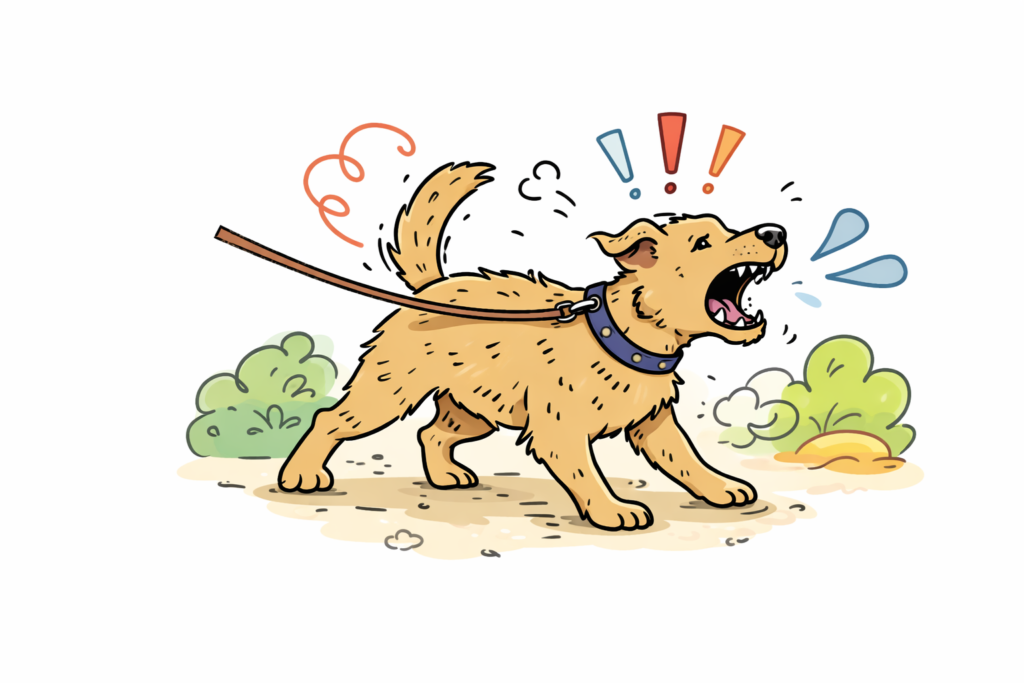
An Open Letter to the pet parent dealing with dog reactivity signs
Dear pet parent,
Feeling confused and unsure when your dog lunges, barks at strangers, or stares intensely for no clear reason is completely normal? Remember the time when a stranger showed disgust just because your dog barked, and you felt ashamed without knowing how to control it? That is, we as pet parents have not been able to identify the dog reactivity signs at its early stage.
When I brought my pup home, she was playful and loved meeting people and dogs, but at first I did not understand why her behaviour suddenly began to change. Right after her first heat cycle, she became a completely changed personality, lunging, barking at people, strangers, and even moving cars. As she grew, I slowly realised the dog reactivity signs in my dog, leading to the next one and a half years full of challenges, and anxiety attacks for me.
When I finally started to understand the dog reactivity signs, it was quite late for me, but manageable. I had to face a year of anxiety attacks, panic attacks when I thought of taking my dog for a walk. But soon, I discovered what does a reactive dog means and how calm and patient training can do wonders. Whether you are a first-time pet parent or a parent dealing with dog reactivity, recognising these early signs may help your dog deal with the wide world.
This article will help you understand the early signs of dog reactivity, so that you can take precautionary measures and train your pet correctly.
What Early Signs of Reactivity in Dogs Usually Look Like in Everyday Life
When I first started noticing small shifts in my dog’s behaviour, I remember thinking, “Is my dog reactive, or am I imagining it”?. Because the truth is, reactive dog signs rarely begin with barking or pulling.
They begin with tiny changes that look harmless. I did not know back then that these were early signs of reactivity in dogs. I simply thought she was distracted or tired after a long day.
But that is exactly how reactivity in dogs develops over the time appearing quietly.
I remember moments where she slowed down for no clear reason, or stared intensely at something far away. Sometimes she showed what I now know were reactive dog symptoms like barking, stiffening, pausing, or refusing to move forward, and taking another route while on walks. At other times, she showed strange behaviour in dogs, such as pacing indoors or suddenly sniffing the ground when nothing had changed. I dismissed these as quirks, not knowing they were part of the signs of reactive dog patterns that behaviourists often talk about.
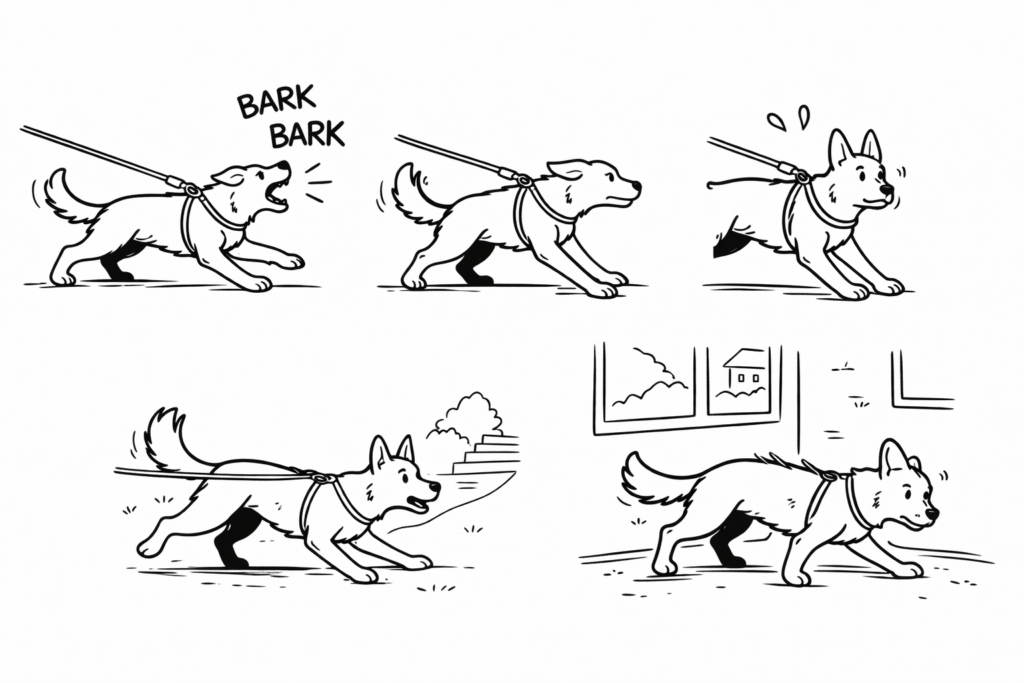
When I started reading more, especially in Behavior Adjustment Training 2.0 by Grisha Stewart, I came across a sentence that changed everything for me. She writes, “Most dogs that bark, lunge, or bite are not inherently aggressive; their behaviours usually stem from emotions such as fear, anger, or frustration. ” That line helped me understand what does reactive dog mean in real life. It means a dog is struggling with internal stress long before we notice the outward reaction.
Turid Rugaas, in On Talking Terms With Dogs, explains that behaviours like lip licking, freezing, or small head turns are early displacement behaviour signals. These are not “bad behaviours”, but they are coping strategies. When I read that, I could finally look back at those walks where my dog was slowing down and realise it wasn’t stubbornness, but fear.
Many dog parents ask online, “Why has my dog had a sudden behaviour change?” or “What triggers a dog to be reactive?”, because so many of us miss the clues. Often, the dog is already experiencing hypervigilance, where their eyes stay fixed and their body tenses before anything even happens. If this continues, trigger stacking builds, meaning several small stressors accumulate until the dog reaches their threshold.
Sometimes the earliest signal is simply dog lunging a tiny bit forward, not aggressively, but due to uncertainty. Other times, it is a refusal to engage or a glance away from something unsettling. These were the moments where I should have slowed down and listened to her body language.
From my experience and research, here is how dog reactivity typically begins:
- Dogs may show small behaviour changes that look normal at first
- Discomfort usually appears before barking or lunging
- Reactivity in dogs often builds through repeated stress or fear
- Subtle signals may be overlooked by owners who are not familiar with them
- Early awareness typically supports calmer behaviour
If I had understood these cues earlier, I would have known how to adjust our walks to stay below her threshold and prevent her from becoming a fear-reactive dog. I also would have started learning sooner about leash reactivity, because that is where many dogs first show discomfort.
Understanding the signs of reactivity in dogs is not about labelling your dog. It is about recognising their emotions before they feel overwhelmed. Once you see these early cues, you cannot unsee them in the best possible way. They become your guide toward a calmer, kinder way of supporting your dog.
Also read article on 8 Powerful Ways Living With A Reactive Dog Helped My Anxiety
Stable Behaviour vs Sudden Behaviour Change in Dogs
Before we understand the difference of different behaviours through comparison, I want to clarify why this matters.
Many pet parents come to this stage feeling confused and worried. They notice a sudden behaviour change in dogs and immediately start asking questions like “Is my dog reactive” or “Why is my dog reactive all of a sudden”. What makes this difficult is that these changes do not always look dramatic. They often sit quietly between normal behaviour and obvious reactivity.
Understanding the difference between stable behaviour and a sudden shift toward reactivity helps explain early reactive dog signs before barking, lunging, or overt fear responses appear. This comparison also helps clarify what is a reactive dog at the earliest stage, when intervention is most effective.
Comparison Table: Understanding Reactivity Thresholds in Dogs
| Stress level | Behavioural signs | What it indicates |
|---|---|---|
| Under threshold | loose posture, soft eyes, responsive | regulated nervous system |
| Early reactivity threshold | slowing down, focused gaze, stiffness | early signs of reactivity in dogs |
| Over threshold | barking, lunging, refusal to disengage | reactive dog symptoms |
| Bite risk threshold | loss of responsiveness, snapping | unsafe stress level |
This table reflects principles discussed in Behavior Adjustment Training 2.0 and supported by stress-response models in veterinary behavioural science.
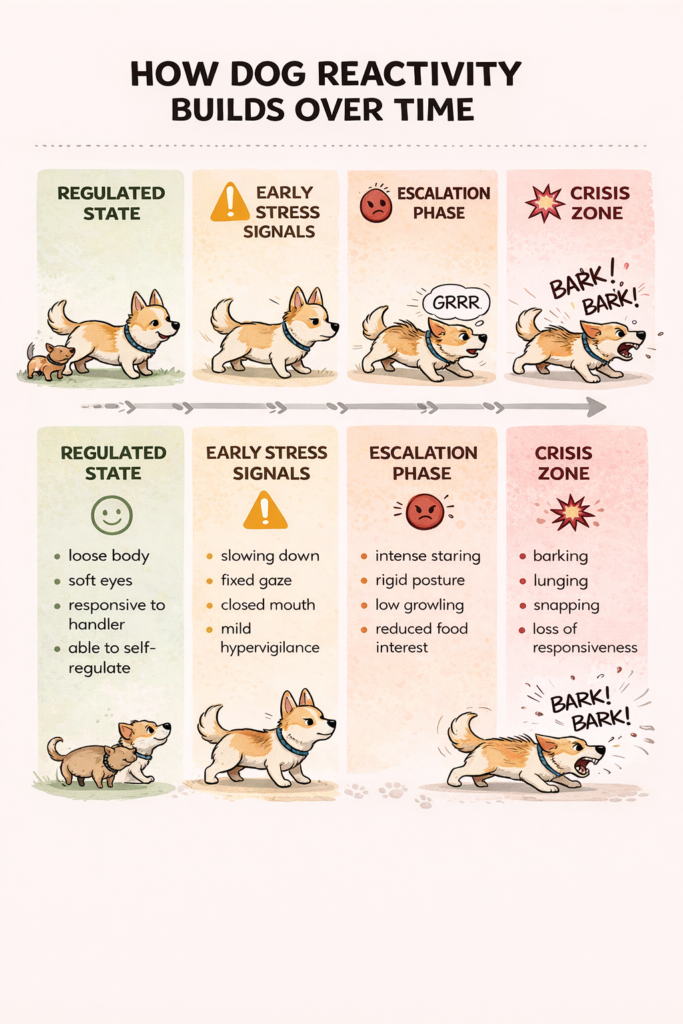
How Dog Reactivity Builds Over Time
When a dog remains in a regulated state, their nervous system can process stress and return to balance. In this phase, behaviour stays predictable. The dog may notice a trigger, but they are still able to disengage, respond to their handler, and recover quickly. This is what stable behaviour usually looks like before any dog reactivity develops.
As the image progresses into the early stress stage, the early signs of reactivity in dogs start to appear. These include slowing down, focused eyes, subtle stiffness, or momentary hesitation. At this point, many pet parents begin asking themselves, “Is my dog reactive?” because these dog reactivity signs often look minor and are easily dismissed as mood changes or distraction.
The escalation phase in the image reflects growing internal stress. This is where reactive dog symptoms become more visible, such as intense staring, freezing, avoidance, or low vocalisation. These behaviours are not random. They represent reactive behaviour in dogs that emerges when stress accumulates.
Veterinary behaviour research explains this process through trigger stacking, where repeated low level stressors build without adequate recovery time. As this continues, the dog crosses their threshold, and emotional regulation becomes difficult.
This explains why fear reactive dogs can appear calm one moment and overwhelmed the next. To the owner, it may feel like a sudden behaviour change in dogs, but the stress has usually been building quietly over time. Once the dog moves beyond this point, behaviours such as barking or dog lunging may surface, especially during leash reactivity, when movement and escape are restricted.
Understanding this progression helps explain why dogs become reactive and why early recognition matters. When pet parents notice these early shifts, they are better positioned to adjust the environment, apply tips for reactive dogs, and learn how to help a reactive dog before the behaviour escalates further.
Why This Comparison Matters in Daily Life
Understanding this difference helps answer practical and commonly searched questions such as:
- why dogs become reactive
- how to help a reactive dog before escalation
- reactive dogs what to do in early stages
Early recognition allows pet parents to apply tips for reactive dogs while the dog is still responsive, instead of reaching the stage where they are urgently searching how to fix a reactive dog or how to stop reactivity in dogs.
Also Read Article on
Ten Alarming Hidden Signs Your Dog Is Becoming Reactive
Before I initiate explaining the early signs of dog reactivity, it is important to mention that at the early days with my dog I just thought, she was a naughty dog, enjoying her childhood or adolescent days. But soon I started noticing changes and continuity of the signs that appeared as mere temporary.
I kept asking myself is my dog reactive or playful or am I overthinking normal behaviour? What I later understood is that reactive dog signs rarely appear suddenly or dramatically. They emerge quietly, through small shifts in body language and responses that many of us dismiss at first. These are often the early signs of reactivity in dogs, and recognising them early can change the entire journey.
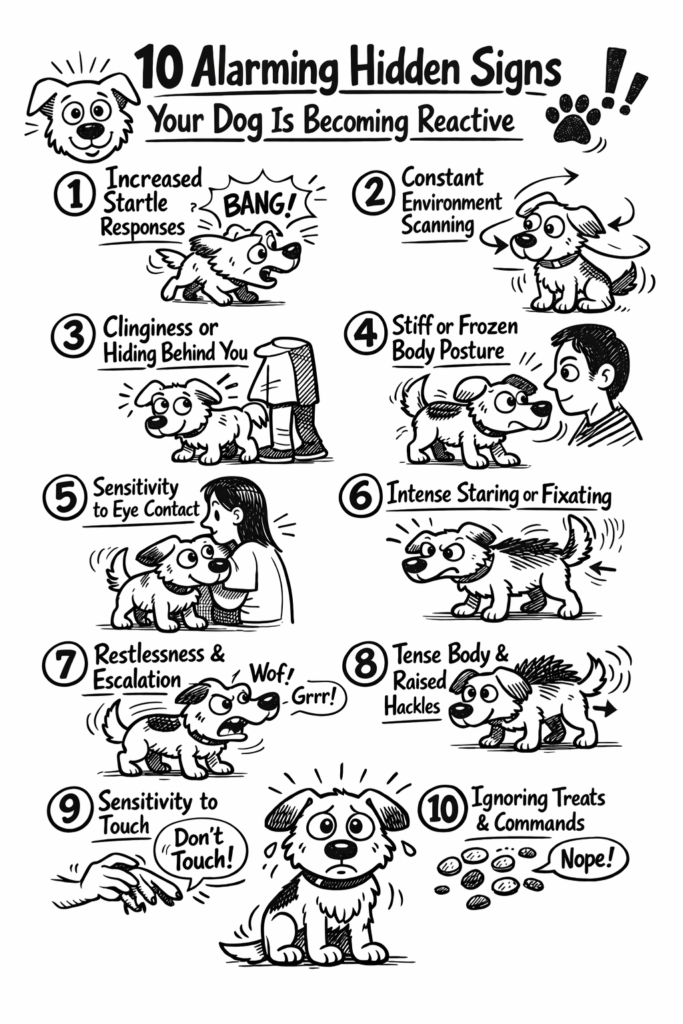
What follows are not extreme behaviours. They are subtle, everyday signs of reactive dog behaviour that I personally overlooked for far too long.
1. Increased startle responses
One of the earliest reactive dog symptoms I noticed was how easily my dog startled. Sounds she once ignored suddenly made her flinch or freeze. This heightened sensitivity is linked to hypervigilance, where the dog’s nervous system stays on constant alert.
In terms of reactivity in dogs, this often means the dog is operating closer to their threshold. They are not overreacting yet, but their capacity to absorb stress is reduced. At this stage, the dog may still appear functional, which is why this sign is so often missed.
2. Persistent environment scanning
I began noticing my dog constantly scanning her surroundings, especially on walks. Her eyes moved quickly, her head stayed slightly elevated, and her focus rarely softened. This behaviour reflects hypervigilance and is one of the clearest signs of reactive dog patterns.
Behavioural science explains that this often results from trigger stacking, where repeated low level stressors accumulate without recovery. Each walk added another layer of stress, even though nothing dramatic happened. To me, it looked like alertness. In reality, it was early dog reactivity forming.
3. Unexpected clinginess or hiding behind you
At one point, my dog started positioning herself behind me when she saw or felt something that I could not. This made me wonder why is my dog reactive when she was once confident. This behaviour is common in a fear reactive dog and often signals that the dog is seeking safety rather than attention. Clinginess is frequently misunderstood as affection, but in the context of reactive behaviour in dogs, it is often a coping response to perceived threat.
4. Stiff or frozen body posture
This was one of the most uncomfortable signs to witness. My dog would suddenly stop moving, her body rigid, mouth closed, and muscles tense and staring at distance. This freeze response usually happens when a dog is nearing their threshold.
Within reactivity in dogs, freezing is often a precursor to escalation. The dog is overwhelmed but still trying to hold themselves together. This moment is critical, yet many owners mistake it for obedience or calmness.
5. Heightened sensitivity to direct eye contact
This is one of the strange behaviour in dogs that I noticed very clearly in my own dog. She did not avoid eye contact. Instead, she tolerated people passing by when they were simply minding their own business. But the moment someone slowed down, stared at her, or tried to engage directly, her reaction changed.
If a person made direct eye contact with her, especially with intent to interact, she would suddenly react. She was not reacting out of aggression, but purely out of fear based response that came from feeling exposed and pressured.
This helped me understand what does reactive dog mean in real life. Reactivity often appears when a dog feels their personal space is being invaded, not when they are being ignored.
Over time, I realised that this pattern is common in a fear reactive dog. Direct eye contact can feel confrontational or threatening, even if the human intention is friendly. When someone passed without acknowledging her, she remained calm. But when someone stopped, stared, or tried to say hello, she crossed her threshold and reacted.
This is also why many owners feel confused and ask, is my dog reactive if she only reacts to certain people. The behaviour seems selective because it is. It depends on how safe the dog feels in that moment. This type of response is part of reactive behaviour in dogs, where emotional perception matters more than the actual situation.
Understanding this helped me stop forcing interactions and instead create space. Once I did that, her reactions became easier to manage, and I finally understood that her behaviour was rooted in fear, not defiance.
Also read other article on Managing My Leash Reactive Dog: 11 Proven Ways I Reduced Leash Reactivity
6. Intense staring or fixating
The opposite of avoidance also appeared. My dog would lock her gaze onto certain people or dogs. This intense focus is not curiosity. It is a stress response tied to hypervigilance.
Sometimes this staring was followed by displacement behaviour, such as sudden scratching or sniffing. These behaviours help dogs regulate stress but often go unnoticed by owners who do not know what to look for.
7. Restlessness and frustration that later escalated
In the early stages, my dog showed restlessness when she saw other dogs, especially off leash ones. She would whine and pull forward, appearing eager to reach them. On its own, this behaviour is not reactivity. Many dogs show this during adolescence or due to excitement or frustration.
What made it significant in my case was how this pattern changed over time. After her first heat cycle, the same situations began triggering intense barking. What felt like a sudden behaviour change in dogs was actually the escalation of an existing response, influenced by hormonal shifts that reduced her ability to regulate stress.
Behaviour research explains that when frustration is repeatedly triggered without recovery, reactivity in dogs may develop. This helped me understand what is a reactive dog in practical terms.
Reactivity does not always begin with aggression. In some dogs, it begins with frustration that gradually intensifies. Looking back, the early restlessness was not a diagnosis, but it was part of a pattern that later became clear.
8. Changes in body posture and visible tension
One of the clearest early signs I noticed was a sudden change in body posture. My dog’s body would become stiff, almost like a plane preparing for takeoff. Her tail would either lift straight up or hold firm in a horizontal ninety degree position, and the fur around her neck and shoulders would rise.
This posture often appeared just before a reaction. These are subtle reactive dog signs linked to rising arousal and stress. When young dogs show this posture repeatedly at four or six months, it should not be dismissed as normal behaviour. Early guidance can help regulate reactivity in dogs before it escalates.
9. Increased sensitivity to touch and handling
Another shift I noticed was increased sensitivity to touch. My dog became uncomfortable with handling she once accepted, such as touching her ears, paws, or during nail trimming. This was not refusal or stubbornness. It felt like hesitation and reduced trust in those moments.
Sensitivity like this can be an early reactive dog symptom, especially when the dog is already stressed. Touch, which is usually reassuring, may feel overwhelming when the nervous system is overloaded. This helped me understand what does reactive dog mean beyond outward reactions. Reactivity can quietly affect how safe a dog feels even with familiar people.
10. Reduced response to treats, commands, and over excitement
I also began noticing moments when my dog stopped responding to treats or familiar commands. Even high value rewards did not register. Instead, she became restless, overly excited, and unfocused. This is often mistaken for disobedience, but it usually means the dog is over threshold.
When a dog cannot take food or respond to cues, learning cannot happen in that moment. This pattern is common in reactive behaviour in dogs and often appears alongside over arousal. Recognising this early helped me slow things down and focus on emotional regulation rather than compliance.
How You May Support Your Dog Once These Signs Start Appearing
When I began recognising these early signals, my biggest question was not about labels. It was why is my dog reactiveand more importantly, what can I do without making things worse.
Understanding what does reactive dog mean helped me realise that reactivity is not misbehaviour. It is communication. Most fear based responses appear when a dog feels overwhelmed, unsafe, or unable to cope with repeated stress.
Behaviour science explains that dog reactivity explanation often comes down to emotional overload. When trigger stacking builds and a dog crosses their threshold too often, reactions become more intense. The goal at this stage is not correction, but support.
Here are approaches that helped me and are commonly recommended in behaviour literature as tips for reactive dogs:
- create physical and emotional space between your dog and the trigger
- choose quieter routes or low traffic times to reduce overstimulation
- keep safe distance while practising focus or calm engagement
- avoid forced greetings or direct eye contact with strangers or dogs
- allow decompression time after stressful situations
- observe patterns to understand why dogs become reactive
Grisha Stewart writes in Behavior Adjustment Training 2.0,
“Creating experiences that are less stressful than a dog’s baseline/threshold can encourage healthy coping mechanisms. “That sentence changed how I approached training. I stopped asking how to fix a reactive dog and started focusing on keeping my dog under threshold.
While other experts argued that such viewpoint may oversimplify the complex behavioural issues in dogs. This helped me understand that stepping back, rather than pushing forward, was often the kindest option.
Supporting a reactive dog is not about doing everything at once. It is about learning how to help a reactive dog feel safer, one situation at a time. When uncertainty continues or reactions intensify, seeking professional guidance can be part of how to deal with a reactive dog responsibly, not a failure.
Recognising these signs early and responding with patience may help slow escalation and even reduce the need to later search how to stop reactivity in dogs. Sometimes, support begins simply by listening more closely to what your dog is already trying to say.
A Simple Real Life Example of early dog reactivity signs
I want to share a moment that completely changed how I understood dog reactivity signs. Until that day, I still wondered, is my dog reactive or just sense. It was a normal summer evening walk. Nothing unusual.
Suddenly, my dog froze. At first, I thought she was being stubborn or distracted. Then I noticed a plastic bag moving on the road because of strong wind. That small movement scared her enough to stop her completely.
At the same time, a car was approaching. That combination pushed her over her threshold. In a split second, she tried to break free from the leash, paniking and attempting to run.
I had to hold her tightl with both hands to prevent her from running into traffic. That moment made me realise the difference between naughtiness, aggression and fear based reactivity.
Looking back, that freeze was one of the early signs of reactivity in dogs. The plastic bag alone might not have caused a reaction, and the car alone might not have either. But together, they created trigger stacking, overwhelming her nervous system. What followed felt like a sudden behaviour change in dogs, but the stress had been building quietly.
That day helped me understand that many reactive dog symptoms begin with small, easily overlooked moments. Recognising them early can help you uerstand why dogs become reactive and how to support them before fear take
How You May Support Your Dog When These Signs Start Appearing
When I started recognising the early dog reactivity signs, my focus shifted from control to support. Learning how to help a reactive dog meant slowing things down rather than pushing through situations.
- Creating space between my dog and her triggers made a visible difference, especially during walks where overstimulation was common.
- Choosing quieternutes, keeping distance while practising calm focus, and avoiding forced greetings helped her stay below her threshold.
- Gentle counterconditioning allowed her to rebuild confidence without pressure.
- Understanding how to deal with a reactive dog is not about fixing behaviour quickly, but about reducing fear and overwhelm.
For many dogs, including mine, these small adjustments were the first real steps toward learning how to stop reactivity in dogs in a compassionate and sustainable way.
To end Our conversation on dog reactivity signs
I would like to reassure that, reactive behaviour in dogs often begins quietly, long before loud reactions appear. Recognising the early signs of reactivity in dogs helped me replace frustration with empathy. When we understand what a reactive dog is truly communicating, we stop searching for quick fixes and start building safety, trust, and calmer experiences together.
FAQs
1. What are the early signs that a dog is becoming reactive, and how do I tell them apart from normal behaviour?
Early signs of reactivity in dogs include freezing, intense staring, sudden stiffness, restlessness, or reduced response to treats. These differ from normal behaviour because they repeat, escalate, and show poor recovery. Reactive dog signs often appear alongside stress signals like hypervigilance or avoidance, not playful curiosity.
2. Why do some dogs suddenly become reactive even if they were calm or friendly before?
What feels like a sudden behaviour change in dogs is usually cumulative. Reactivity in dogs often develops through trigger stacking, hormonal changes, fear experiences, or chronic stress. The dog may have been coping quietly until their threshold was crossed, making dog reactivity appear sudden to the owner.
3. What is the 7 7 7 rule for dogs?
The 7 7 7 rule for dogs describes the typical adjustment phases after a major change like adoption or relocation. The first 7 days are about decompression and confusion, the next 7 weeks focus on learning routines and building trust, and the final 7 months reflect emotional settling. It helps set realistic expectations for behaviour and bonding.
4. What is the hardest command to teach a dog?
The hardest command to teach a dog is often reliable recall, meaning coming when called in all situations. Distractions, fear, excitement, or reactivity can override training. For reactive dogs, recall becomes harder because emotional arousal interferes with learning. Success depends on emotional regulation, consistency, gradual exposure, and training below the dog’s threshold rather than repeated repetition.
5. How to stop dog reactivity at home?
To stop dog reactivity at home, reduce exposure to triggers, create predictable routines, and manage the environment first. Use barriers, calming enrichment, and reward calm behaviour before reactions start. Focus on emotional regulation rather than correction. Consistent counterconditioning, adequate rest, and avoiding repeated stress help lower reactivity over time.