

An Open Letter to the Pet Parent Who’s Wondering “Is This Normal?”
You were not searching for it, but here you are looking for an answer why your reactive dog barks at everything they see or hear? It probably happened in between a yawn, a sigh, or a moment where you told yourself, “It’s fine, dogs bark.”
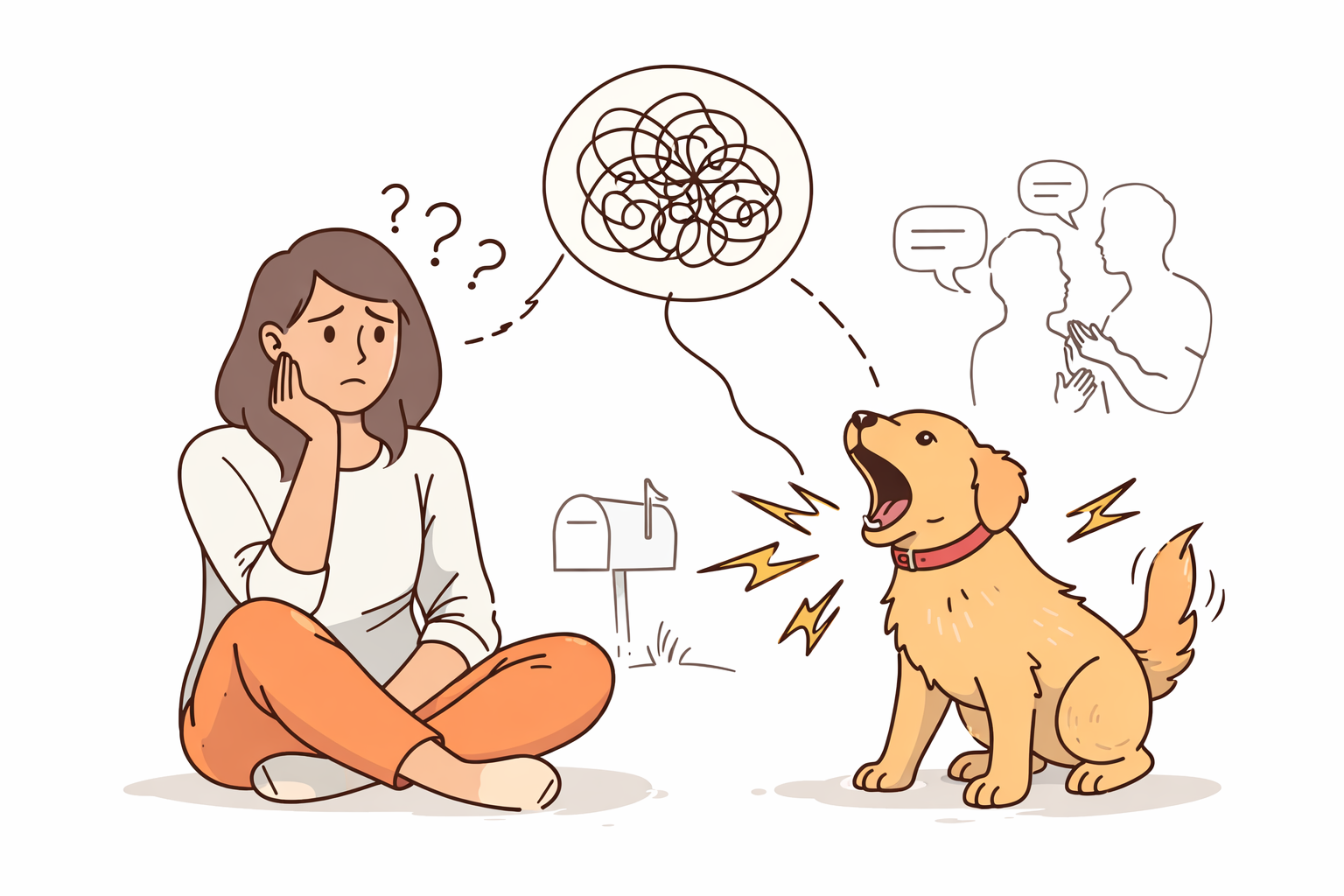
Maybe you were sitting together in a quiet, cozy space, nothing dramatic, no chaos and suddenly a faint footstep outside the door, someone talking in the distance, a sound you barely noticed and your dog erupted into barking so intense it startled you. Maybe you were on a calm walk, the kind you actually enjoy, when your dog paused, stiffened for a second, and then started barking at something you couldn’t even fully see.
You found yourself standing there, embarrassed, confused, apologising with your eyes to strangers who don’t know your dog, don’t know you, and definitely don’t know how hard you’re trying.
You thought that your dog might be barking for no reason, or that your dog is just “too alert” or “too vocal.” You may even tried to shush them, pull the leash tighter, or gently hold their mouth closed in a hallway because you didn’t want complaints, stares, or that familiar knot in your stomach.
If this sounds familiar, you’re not imagining the change or it is just not started just like that. Many pet parents notice that their dog isn’t just barking occasionally, but barking at every noise, every pause, every unexpected moment. With that comes something no one really talks about: the quiet shame, the awkward explanations, the fear that others think you’re doing something wrong.
As you read on, you will eventually explore the reasons behind sudden barks and the change in your dog’s behaviour that didn’t appear overnight.

The “Is This Normal?” Check Most Pet Parents Miss About Barking Behaviour in Dogs
When I first noticed how often my dog barked, I dismissed it as “just something she does.” After all, dogs bark, that’s part of life with a canine companion. But that innocent assumption quickly dissolved the day she began barking at everything in ways that felt far from routine. It wasn’t just the doorbell or guests at the gate. It was silence that seemed to prompt it, a faint sound in the street that barely registered to my human ears, even an object she had passed by countless times before.
The shift was subtle at first, a sudden increase in barking, but over weeks it became undeniable. I found myself asking the very questions so many pet parents whisper to themselves: Why is this happening? Why now? Is she barking for no reason? These are the moments most of us overlook until we cross an unseen threshold, and by then it feels like the barking has taken on a life of its own. Now the main challenge is that here we are not talking about the usual or normal dog barking but we are focusing on something that is beyond the subject that has been talked about so far.
Excessive dog barking does not only imply to alertness or a dog simply making noise, but for certain cases specifically for dog reactivity, excessive barking is a form of communication not a normal communication but a fear based communication. Traditional discussion on barking behavior in dogs remind us that barking is a form of communication but, have we ever focus on why a dog is barking in certain but I know that simply projects fear or anxiety or protection?

When I began paying close attention, patterns emerged that I had completely missed. The kind of barking that most pet parents consider normal, the sharp bark at the doorbell, the brief alarm when someone arrives; is usually tied to a clear and present stimulus. But what really unsettled me were the moments when there wasn’t an obvious trigger, a sound that was too faint to be meaningful, a familiar environment that once felt secure, or times when she barked before I could even notice a change around us.
At that point, the barking stopped feeling like communication tied to a specific event and started feeling like something had subtly shifted in how her nervous system processed the environment. In canine behavioural science, researchers have long observed that so-called nuisance or problem barking can arise from recurring patterns deeply rooted in the dog’s response system, not just external triggers.
Bark!: The Science of Helping Your Anxious, Fearful, or Reactive Dog by Dr. Lisa Radosta explores how excessive barking is rarely a training failure and more often a nervous system stuck in chronic vigilance, where everyday sounds and sights are processed as threats rather than background noise. The book reframes barking as a stress response rooted in fear, anxiety, and emotional overload, not disobedience.
What stayed with me is Dr. Radosta’s honesty about once being afraid of dogs herself, and how that fear taught her what it feels like to live in a world where everything others find normal feels overwhelming. That is exactly how many dogs who bark at everything experience life their nervous system never truly rests, living in a near-constant state of alert, caught between fight, flight, and the inability to switch off.
Understanding these early shifts is crucial, because this is exactly where many problems quietly begin. A dog’s silent signals, posture changes, slight tension, or anticipatory vocalisations, are part of a larger system of dog communication signals. They seldom resolve on their own, and the more we dismiss them as personality quirks, the more likely they are to solidify into entrenched patterns that feel harder to unravel later.
Also read article on 10 Startling dog reactivity signs you may be overlooking
7 Reasons Your Reactive Dogs Barks At Everything
While it is important that as a pet parents, you should not carry the anxiety of having a pet, it is also important for you to understand the reason behind why your reactive dog barks at everything. A sudden increase in barking does not mean, your dog is disobedient or just playful, but it needs close attention from a psychological point of view. Here are the 7 reasons why your reactive dog barks at everything.

Reason 1: Fear and Anxiety Response
The most common driver behind excessive dog barking causes is fear. When my dog barked suddenly at people, sounds, or even nothing visible, it wasn’t aggression. It was distance-creating behaviour. Barking is often the only tool a fearful dog has to say, “I don’t feel safe.”
Behavioural studies describe this as a fear-based response where barking functions as a warning signal, not a threat. According to Overall (2013) in Clinical Behavioral Medicine for Small Animals, anxiety-driven barking emerges when a dog perceives unpredictability or loss of control in its environment. This explains why pet parents often ask, “Why is my dog barking for no reason?”—the reason exists, but it’s internal.
Reason 2: Territorial and Protective Instincts
Some barking behaviour in dogs is rooted in the psychological need to guard what feels important; home, space, or even the owner. I noticed this clearly near doors, windows, and hallways. The barking intensified not because someone entered, but because someone might. What goes on in their mind is “This is mine. Do not come closer.”
The Journal of Veterinary Behavior explains territorial barking as an instinctive response amplified in dogs with heightened arousal levels. In reactive dogs, this instinct doesn’t switch off once the “threat” passes, leading to dog barking louder and longer than expected.
Reason 3: Anticipatory or Hyper-Vigilant State
This was the most difficult phase for me when my dog would pause on walks, freeze, and then bark before anything happened. This is not reaction, but anticipation, a form of reactive dog communication signals.
Behaviourists describe this as a hyper-vigilant state, where the nervous system is constantly scanning for danger. Barking begins before a trigger fully appears, explaining the sudden increase in barking many pet parents report. Dr. Lisa Radosta and others in From Fearful to Fear Free: A Positive Program to Free Your Dog from Anxiety, Fears, and Phobias explains how reactive dogs live in a near-constant fight-or-flight mode, unable to return to baseline.
Reason 4: Boredom or Lack of Stimulation
Not all reactive barking looks dramatic, sometimes it sounds restless. Barking becomes a coping mechanism, a way to release internal tension. I saw this when barking appeared during quiet moments, not chaos.
Caroline Clark (2023), frames this as under-stimulation leading to self-reinforcing behaviours. Over time, barking itself becomes regulating. This is why dog barking triggers aren’t always external and why telling a dog to “stop” rarely works.
Reason 5: Stress-Induced Sensory Overload
At one point, my dog began reacting to the smallest sounds like footsteps, distant voices, keys. This is classic dog barking at noises due to lowered tolerance thresholds.
Repeated exposure without recovery overwhelms the nervous system. Research shows that chronic stress reduces a dog’s ability to filter sensory input, turning neutral sounds into perceived threats. This explains why pet parents say, “My dog barks at everything now.”
Reason 6: Learned Reinforcement
Over time, I realised something very unsettling that for my dog the barking worked. Every time my dog barked, the person walked past, the other dog disappeared, or the sound eventually stopped. From a behavioural psychology standpoint, this is negative reinforcement. The scary thing goes away because of the barking. So the message became; “I barked. The threat left. I should do this again.”
This explains why a sudden increase in barking can quietly turn into a long-term pattern. Dr. Karen Overall explains in her work that once barking becomes self-reinforcing, it is no longer a reaction to the present moment but a learned survival strategy.
Reason 7: Emotional and Physical Relief
Another important factor that I realised, watching my dog bark is that she seemed exhausted or somehow relived. Barking in a high-arousal state releases physical and emotional tension. Even though, It’s not healthy relief, but it is relief which makes the cycle is so hard to break. The barking temporarily eases internal discomfort.
As Dr. Lisa Radosta explains in Bark!: The Science of Helping Your Anxious, Fearful, or Reactive Dog, barking is often the outward expression of an overwhelmed nervous system trying to regulate itself the only way it knows how.
Also read our article on Managing My Leash Reactive Dog: 11 Proven Ways I Reduced Leash Reactivity
In my 2 years of time with my reactive dog, I always heard a common question or assumption; ‘Does she bite? or ‘She is aggressive’. This did not come from others, but pet parents questionning ‘ why my reactive dog barks at everything and everyone, despite seeing them everyday. Here breed tendencies also plays a big role, but that needs separate attention to discuss.
When we look at reactive barking through this lens, it stops being about “how do I make my dog stop barking?” and starts becoming about understanding reactive dog communication signals. Because barking that has persisted for years is not defiance, it is information and ignoring it, suppressing it, or punishing it only deepens the cycle.
Understanding Barking Behaviour in Dogs: Normal Barking vs Reactive Barking vs Aggression
Once you understand the reasons behind barking, the next confusion almost always sounds the same;
“But how do I know if this is just barking… or something more serious?” This question comes up especially when a reactive dog barks at everything like at people, at sounds, at movement, sometimes even at nothing obvious at all. The intensity makes pet parents fear the worst, often jumping straight to labels like “aggressive” or “dangerous.”
This distinction matters deeply, because how you respond depends entirely on what kind of barking you’re seeing. Treating reactive barking like aggression can escalate fear while treating it like normal barking can be unsafe. However, treating fear-based barking as disobedience almost always makes things worse.
From a behavioural science perspective, barking behaviour in dogs exists on a spectrum, shaped by emotional state, learning history, and nervous system regulation. Understanding where your dog’s barking sits on that spectrum is the first step toward responding in a way that actually helps.
Normal Barking vs Reactive Barking vs Aggressive Behaviour
| Aspect | Normal Barking | Reactive Barking | Aggressive Behaviour |
|---|---|---|---|
| Primary driver | Communication or alert | Fear, anxiety, stress | Intent to threaten or cause harm |
| Trigger clarity | Clear and immediate | Often distant, vague, or anticipatory | Direct and specific |
| Emotional state | Calm to mildly alert | Overwhelmed or hyper-vigilant | Highly aroused, confrontational |
| Recovery time | Quick and easy | Slow or incomplete | Escalates without intervention |
| Common examples | Doorbell, visitor arrival | Dog barking at everything, barking at noises, barking at people and sounds | Lunging, snapping, biting |
| Most common misunderstanding | “My dog is vocal” | “My dog is aggressive” | “This came out of nowhere” |
Why Reactive Barks Is So Often Mistaken for Aggression
I’ll be honest, there was a time when even I wondered if what I was seeing was aggression. When a dog is barking loudly, repeatedly, and with that kind of intensity, it looks aggressive from the outside. People around me assumed I and slowly, started questioning it too, especially when there was a sudden increase in barking that startled them.
But living with a reactive dog every day taught me something very different. What I began to notice was that my reactive dog barked at everything not because she wanted to confront, but because she wanted space or even curious. The barking wasn’t a challenge, it was a request, a communication or a call. When people came closer, when sounds felt unpredictable, when movement appeared too suddenly, her barking wasn’t about control or dominance, its either about accessing the human touch or communicating that ‘I don’t feel this right‘, Please don’t come any closer. I don’t feel safe.”
Over time, it became clear that this wasn’t aggression at all, but it was fear-based reactivity. All the things that build quietly inside a dog long before they ever bark. This is why barking behaviour in dogs, especially reactive barking, is so often misunderstood. From the outside, people only hear the noise, but from the inside, the dog is coping with an overwhelmed nervous system.
I remember asking myself the same questions I now hear from so many pet parents:
Why is my dog barking so much now?
Why is my dog barking at everything all of a sudden?
Why can’t I get her to stop, no matter what I do?
What veterinary behaviour science helped me understand, and what my lived experience confirmed, is that most dogs labelled “aggressive” in everyday situations are not showing intent to harm. According to behavioural research, by Dr. Lisa Radosta excessive dog barking causes in reactive dogs are far more likely to be rooted in anxiety, learned patterns, and internal triggers than in true aggression.
Once I saw it this way, everything shifted that told me, the barking wasn’t about defiance, disobedience, dominate a situation but it was about coping in a world that felt too loud, too fast, and too unpredictable. Understanding this difference is what changed how I responded, how I advocated for my dog, and how I stopped internalising the fear and judgment that came with every barking episode.
How Pet Parents Should Respond When a Reactive Dog Barks at everything
This part took me the longest to understand, because everything in you wants to stopthe barking. Especially when your reactive dog barks at everything and people are staring, judging, or stepping away. But over time, I realised this phase is not about fixing anything yet, but not making things worse.
When my dog started barking louder and more frequently, especially during a sudden increase in barking, my instinct was to correct her not to quiet her or control the situation. But what I slowly observed was that in those moments, she was already in fight-or-flight where her nervous system was flooded. Expecting calm behaviour from a dog in that state was like asking someone to relax while panicking.
What helped most in the moment wasn’t commands but predictability. When I stayed physically calm, moved away from the trigger when possible, and avoided tightening the leash or scolding, the episode passed faster. Even something as simple as acknowledging her presence without adding pressure changed the tone of the moment. I wasn’t rewarding the barking, I was reducing threat perception which mattered more than silence.
On the other hand, I saw very clearly what made things worse, even when my intentions were good. Raising my voice, repeating “no” again and again, forcing her closer to whatever she was reacting to, holding her mouth shut in hallways so people wouldn’t complain. In hindsight, those responses didn’t teach her anything, they only confirmed what her body already believed; something really is wrong here. From a behavioural standpoint, those reactions reinforced the very excessive dog barking causes I was trying to stop.
Living through this taught me that barking behaviour in dogs, especially reactive barking, isn’t a discipline issue, It’s a communication issue. It was my dog telling me she was overwhelmed by sensory triggers I couldn’t always see, whether that was dog barking at noises, movement, or internal stress building up long before the sound.
This is also where I learned to separate response from training. Training absolutely has a place, but timing and approach matter more than most people realise. Reactive barking rooted in fear, anxiety, or sensory overload cannot be addressed through obedience commands alone. Behavioural modification focuses first on nervous system regulation, understanding trigger thresholds, and controlled exposure, not suppression.
Structured approaches like desensitisation and counter-conditioning, which are widely recommended by veterinary behaviourists, work best after pet parents truly understand what their dog is communicating. Training is not about stopping the bark, It’s about helping the dog feel safe enough that barking is no longer necessary.
What Actually Helps First (Before Training or Obedience)
When I finally discovered the reasons why my reactive dog barks at everything, I started focusing on what could be done to help my dog while stop all the external noises that added unto my anxiety and made me think I am not a good pet parent.
- Never rush into obedience or formal training as when a reactive dog is overwhelmed, asking for obedience adds up to the pressure. Understanding the triggers is the first thing to do to her them.
- Forced exposure are never the answer to their reactivity, it rather worsen their anxiety and fear.
- Timing matters the most, when a dog is ready to explore that moment works as a positive foundation for learning for a reactive dog.
- Short walks during off-peak hours like early morning or late night reduce sensory overload while helped my dog get accustomed with triggers slowly.
- Make a clear list of triggers or use a reactive dog trigger tracker.
- Reward calm behaviour and impulse control that let the dog learn that staying regulated feels safe and earns good things.
- Most importantly, shouting or scolding would not solve the issue, rather your calmness works as a link to your dog’s ability to cope with the world.
One Last Thing Worth Remembering
What changed everything for me was letting go of the idea that my job was to control my dog’s behaviour in public. My real responsibility was to protect her emotional safety while she learned to navigate a world that felt too loud, too fast, and too unpredictable.
When you respond with understanding instead of urgency, with observation instead of correction, you stop fighting the symptom and start addressing the cause. And that’s when real change becomes possible, not overnight, not easily, but honestly.
FAQs
I asked myself this exact question when my reactive dog barked at people, sounds, and even silence. What I learned is that when a reactive dog barks at everything, it’s rarely about the trigger itself. It’s usually a nervous system stuck in constant alert mode, reacting before it can process safety.
If a reactive dog barking at everything, it always has a cause, and most often it begins with the nervous system. Dogs do not experience the world as safe or predictable the way humans do. When a dog barks at every noise outside, it reflects a heightened nervous system stuck in constant alert mode. The barking is not random; in the dog’s mind, that sound could signal a threat. Barking becomes a way to protect itself or its territory. Reactive dog barks at everything often live with ongoing anxiety and fear of the unknown.
When a reactive dog barks at everything, we often miss the most important question to ask: what is triggering the bark? Instead of focusing only on the noise, it is important to identify the sources that activate a reactive dog’s fear and work on reducing it gradually. This process requires compassion, understanding, positive reinforcement, and time, not urgency or punishment.
I used to believe there was “no reason” too, until I realised the reason wasn’t external. A sudden increase in barking often comes from internal pressure building over time. Fear, anxiety, or lack of recovery don’t announce themselves, they leak out as barking.
This confused me for months. What I learned is that reactive dogs don’t respond to people, they respond to patterns but to movement, posture, tone, unpredictability. Barking behaviour in dogs is shaped by what feels unsafe, not by logic or familiarity.Reactive dogs function on energy due to their hyper vigilant nature, when a person’s body energy shifts from relaxed to alert, that ignites the reactive barking to some people, while others carrying a calm posture and energy would not trigger even a reactive dog.
When this happened to us, I panicked. Adult dogs don’t “become bad” overnight. Sudden barking changes usually mean stress has crossed a threshold. Once that happens, even familiar environments can feel overwhelming, triggering reactive barking that looks random but isn’t. Sometimes, hormonal changes at an adolescent stage of an adult dog triggers reactivity to the environment as well.